
Promoting Environmental Awareness for Community Health (PEACH)

At a glance

The PEACH visual tool provides concise information about pesticide safety for patients. Learn how exposures to pesticides occur and how to reduce these.
Pesticide Safety

PEACH Page 1
PEACH Page 1

Promoting Environmental Awareness for Community Health (PEACH)

Pesticide Safety

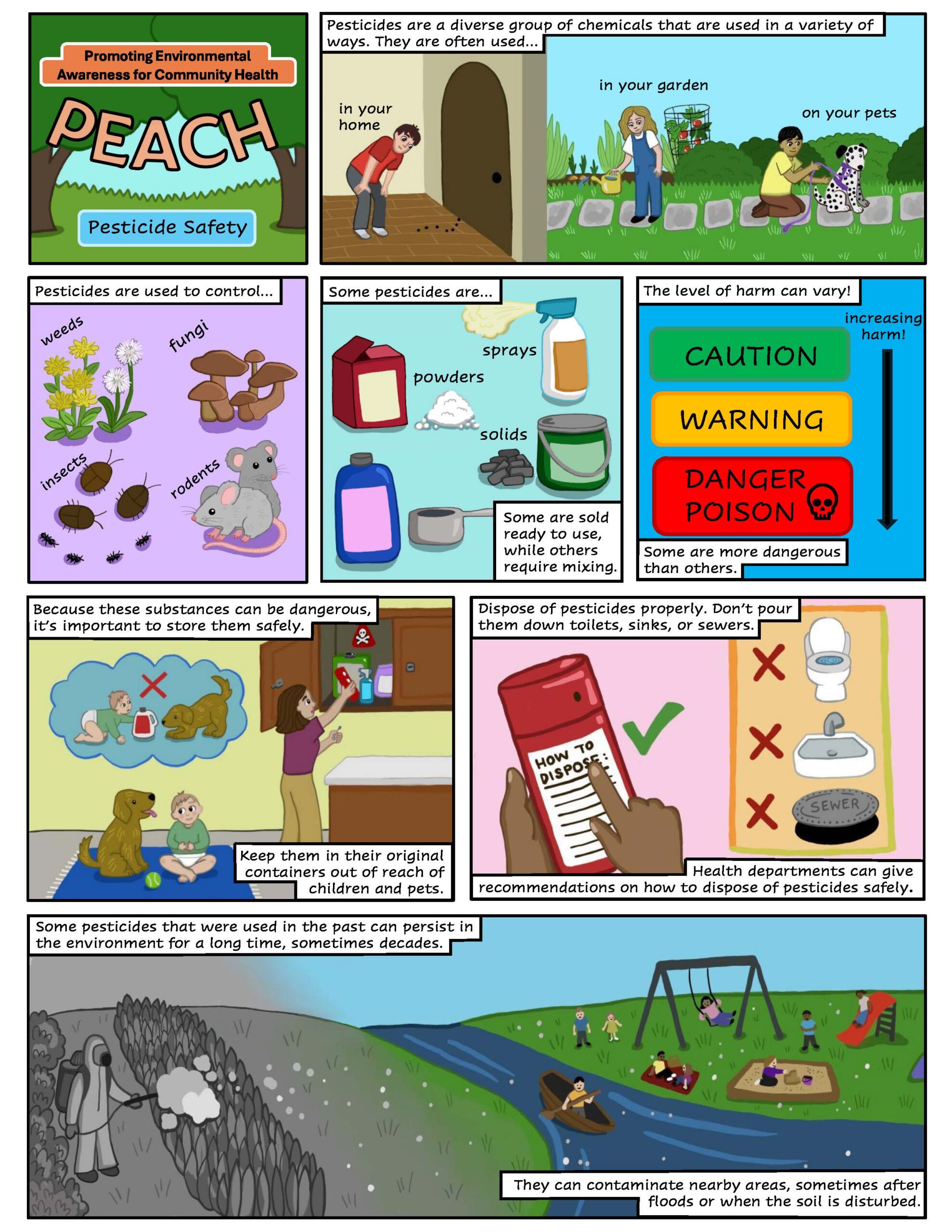
  • Pesticides are a diverse group of chemicals that are used in a variety of ways. They are often used: in your home, in your garden, on your pets.
  • Pesticides are used to control: weeds, fungi, insects, rodents.
  • Some pesticides are: sprays, powders, solids.
  • Some are sold ready to use, while others require mixing.
  • The level of harm can vary: Caution- Warning- Danger Poison! Some are more dangerous than others.
  • Because these substances can be dangerous, it's important to store them safely.
  • Keep them in their original containers out of reach of children and pets.
  • Dispose of pesticides properly. Don't pour them down toilets, sinks, or sewers.
  • Health departments can give recommendations on how to dispose of pesticides safely.
  • Some pesticides that were used in the past can persist in the environment for a long time, sometimes decades.
  • They can contaminate nearby areas, sometimes after floods or when the soil is disturbed.
PEACH Page 2
PEACH Page 2
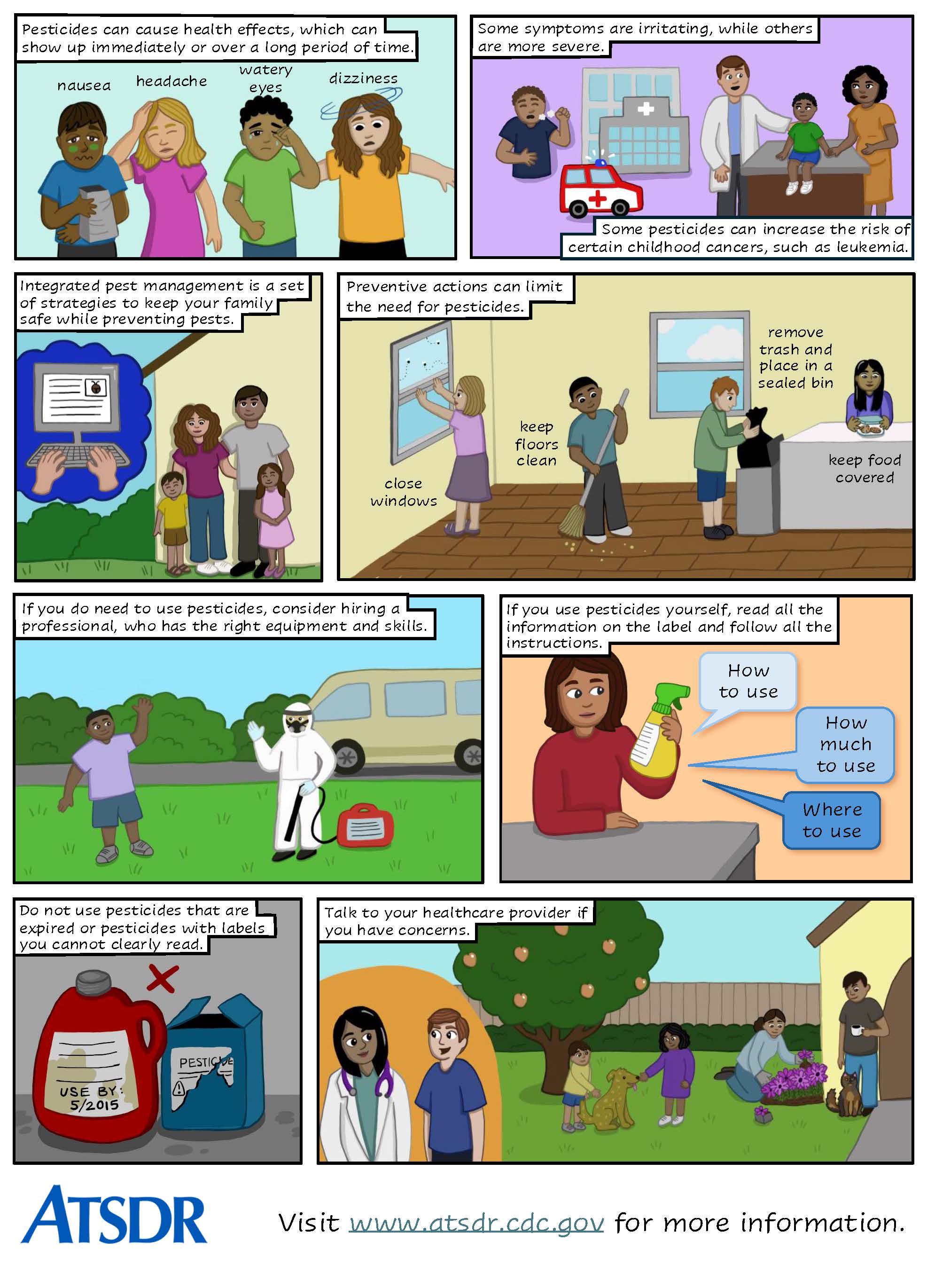
  • Pesticides can cause health effects, which can show up immediately or over a long period of time: nausea, headache, watery eyes, dizziness.
  • Some symptoms are irritating, while others are more severe.
  • Some pesticides can increase the risk of certain childhood cancers, such as leukemia.
  • Integrated pest management is a set of strategies to keep your family safe while preventing pests.
  • Preventive actions can limit the need for pesticides: close windows, keep floors clean, remove trash and place in a sealed bin, keep food covered.
  • If you do need to use pesticides, consider hiring a professional, who has the right equipment and skills.
  • If you use pesticides yourself, read all the information on the label and follow all the instructions: how to use, how much to use, where to use.
  • Do not use pesticides that are expired or pesticides with labels you cannot clearly read.
  • Talk to your healthcare provider if you have concerns.

Visit www.atsdr.cdc.gov for more information.

PDF Version

View PDF version

Contact Us

For more information about these products, email ATSDR's Environmental Medicine and Health Systems Intervention Section at envmed@cdc.gov.

For questions or information on other products and topics, contact CDC–INFO.